
How to Check Lafayette County Criminal History
Begin with the record that can answer the question. The Lafayette Online Court Records Search, or OCRS, provides the county route to case details, filings, and hearing information. The Lafayette County Sheriff's Office keeps incident, arrest, and booking material. The Florida Department of Law Enforcement, or FDLE, compiles reported Florida arrest and disposition cycles. These products overlap, but none replaces the others.
Gather a full name, birth date when lawfully available, spelling variants, and any known case or incident number. Confirm each match through dates, agency names, and court data. Name-only results can join the wrong person to a record, and a new filing may not appear online at once.
- Choose Public access in OCRS when the goal is a filed Lafayette County court case.
- Call the jail at 386-294-4381 for present local custody because Lafayette County publishes no online jail roster.
- Request an incident or arrest report from the sheriff by phone, email, mail, or at the records counter.
- Use FDLE for the statewide Florida history product or a free fingerprint Personal Review of your own record.
- Ask the clerk or originating agency for a certified copy when an authenticated local document is needed.
Three Lafayette County Record Offices
Lafayette County criminal records split across three custodians. The Clerk of Circuit Court and Comptroller records what prosecutors file and what judges decide. The sheriff documents investigations, arrests, jail intake, and local custody. FDLE receives qualifying fingerprint-linked arrest data and later disposition reports. A charge can change as it moves through this chain, so readers should compare the agency report with the clerk's case and the state history.
That comparison also reveals timing gaps. Record the date each source was checked, then ask the office that created a disputed entry to confirm or correct it.
| Source | Best for | Main route |
|---|---|---|
| Lafayette Clerk | Dockets, filings, hearings, judgments | OCRS, counter, phone, or mail |
| Lafayette Sheriff | Reports, booking, jail, warrant checks | Records request or direct phone |
| FDLE CJIS | Reported Florida history cycles | Instant, staff search, or Personal Review |
The Lafayette Clerk homepage shows the courthouse contact block used for court files.
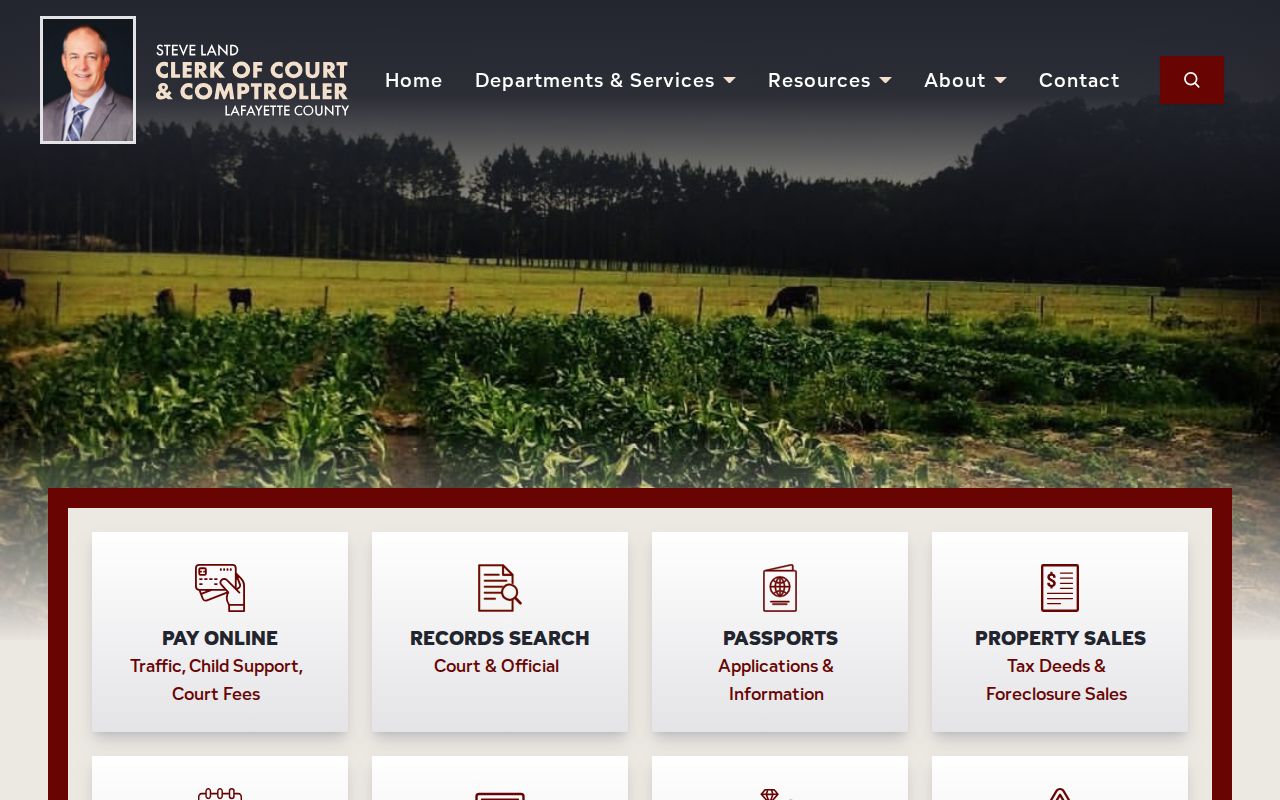
That clerk channel belongs beside, not in place of, sheriff and FDLE checks.
Official Florida Background Checks
The FDLE State of Florida Criminal History Record Check offers Instant Search, staff-run certified or noncertified searches, and ORI searches for authorized recipients. Instant Search costs $24 plus a $1 card-processing fee and produces a printable or emailable result that is not certified. Staff searches cost $24; the stated processing time is five business days for noncertified work and six to seven for certified work, before mail time.
A free fingerprint Personal Review is limited to the subject or a designated attorney. It is the right route to inspect and challenge your own Florida record. Prints must be taken by a law-enforcement or criminal-justice agency and mailed with the FDLE form. Authorized state and national checks use an agency ORI and an FDLE-registered Livescan submitter.
The official FDLE check-options page distinguishes Instant, certified, and ORI products.
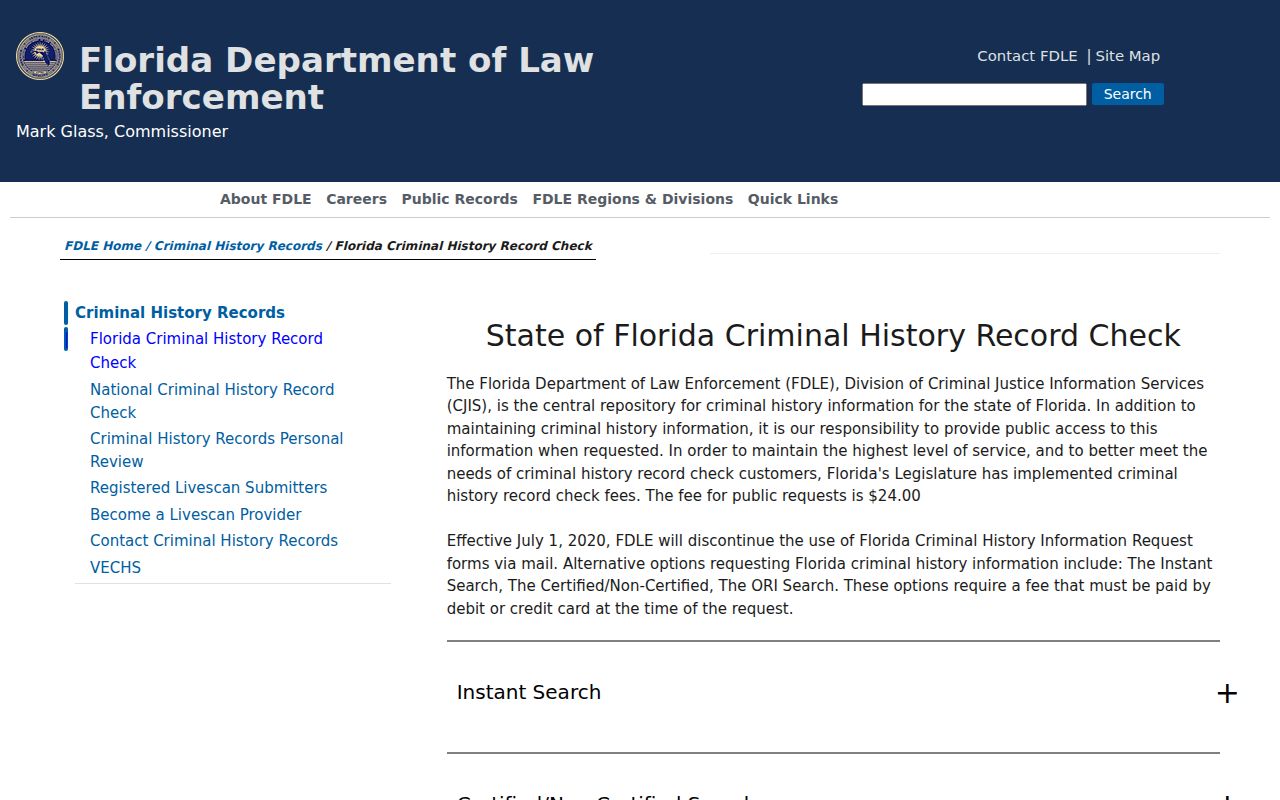
The choice affects cost, identity assurance, delivery, and whether the result is certified.
Lafayette County FDLE Search Choices
FDLE's public name search is broad, but it is not biometric proof. Use it with enough identifying facts to avoid a false match. For self-review, fingerprints make the Personal Review a stronger accuracy tool. The public product and the free subject-review product serve different needs.
| Product | Agency fee | Key limit |
|---|---|---|
| FDLE Instant | $24 plus $1 card fee | Not certified |
| Certified or noncertified staff search | $24 | Mail adds delivery time |
| Personal Review | $0 | Own record or designated attorney only |
| FBI Identity History Summary | $18 written request | Fingerprint subject-access product |
The FDLE Instant Search interface is the paid statewide entry point.
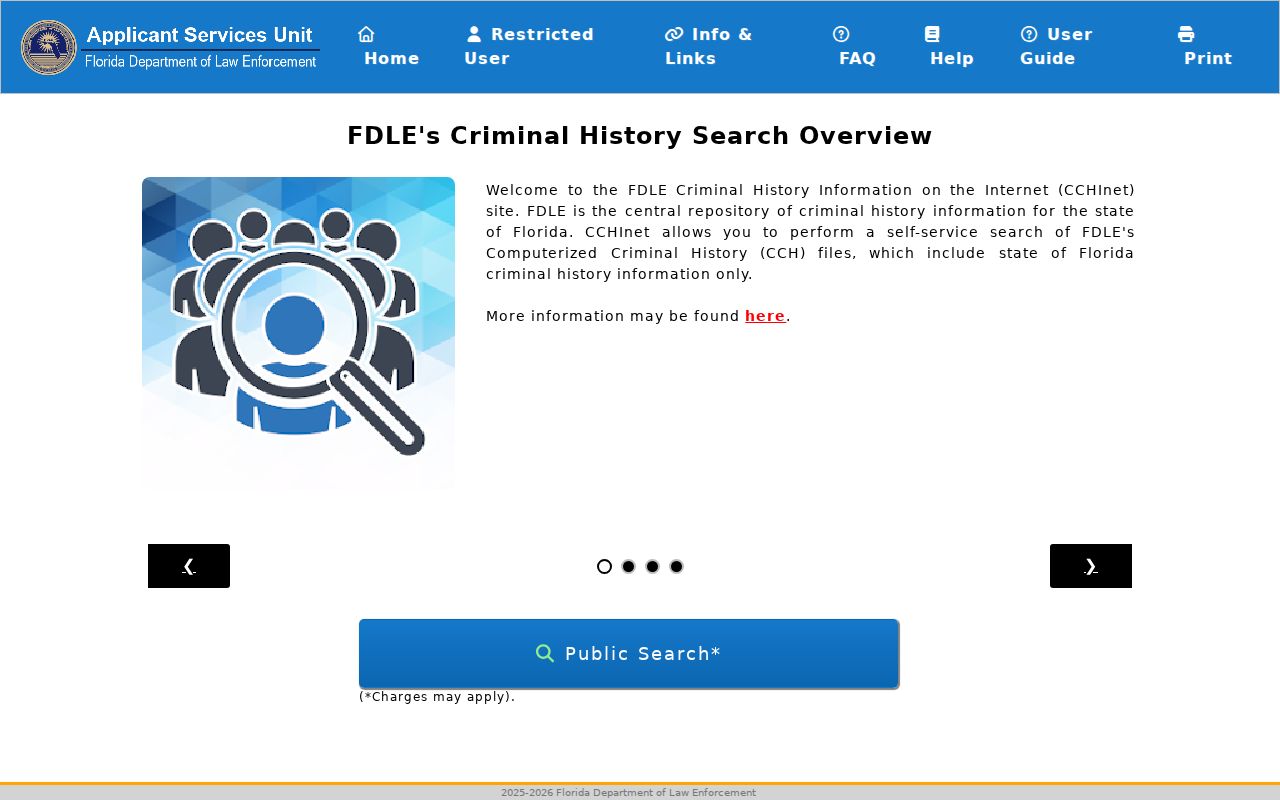
Its result should be checked against the originating Lafayette County court or agency record.
Types of Criminal Records
A Lafayette County incident report describes an agency's investigation. A jail booking record documents intake and custody. The court file shows the charge actually filed, docket events, outcome, and sentence. FDLE's history assembles reported Florida arrest and disposition cycles. Warrant, supervision, and registry records use still other systems.
Keeping those sources separate prevents a common error: treating an arrest allegation as a conviction. It also explains why a sheriff report can exist before OCRS shows a case, or why FDC has no result for a person held only in the county jail.
- Arrest and booking records describe agency action and jail intake.
- Criminal court files show filed counts, hearings, disposition, and sentence.
- FDLE histories compile reported fingerprint-linked state cycles.
- Warrant records provide leads that require local confirmation.
- Custody, supervision, and registry records track distinct legal duties or status.
No Lafayette County Jail Roster
Lafayette County does not publish an online jail roster or recent-booking log. For current custody, call the Lafayette County Jail at 386-294-4381. For a releasable booking record, use the sheriff's public-record channels: 386-294-1222, records@lafayetteso.org, the counter at 231 NW Monroe Avenue, or mail to PO Box 227, Mayo, FL 32066.
The absence of a web profile means no standard list of public fields can be promised. Do not borrow a neighboring county's roster format. Medical, security, classification, juvenile, victim, and other exempt information may be withheld even when basic custody facts are public.
What a Lafayette County Criminal Record Shows
The contents depend on the custodian. A Lafayette County court file is organized around the case number, filed charges, hearings, documents, disposition, sentence, and financial entries. An arrest report centers on the event and probable-cause account. A jail record centers on identity and custody. FDLE organizes a history around reported arrest and disposition cycles.
| Name & Identifiers | Names and identity details released by the custodian; protected identifiers are redacted. |
|---|---|
| Arrest / Booking Data | Agency, date, initial allegation, intake, bond, and custody movement when released. |
| Charges & Statutes | Initial allegations or prosecutor-filed counts, which may differ. |
| Disposition | Dismissal, nolle prosequi, plea, acquittal, conviction, or other court result. |
| Sentence | Jail, prison, probation, costs, or other terms entered by the court. |
| Custody / Supervision Status | County jail, FDC prison, or felony supervision status from the proper source. |
Blank Lafayette County Searches
A blank screen is not a clean-record certificate. OCRS may not yet show a new filing, a document may require a different access role, or the matter may be confidential, sealed, archived, or temporarily unavailable. A sheriff report can exist even when the State Attorney files no court charge. Likewise, the FDLE cycle can lag a local disposition.
Call the clerk at 386-294-1600 for a missing court file. Ask whether it is public, archived, delayed, or available only at the counter. For an agency report, contact the sheriff. For errors in your own statewide history, use FDLE Personal Review and its challenge process.
The OCRS gateway displays Public, Attorney, Registered User, and Party choices.
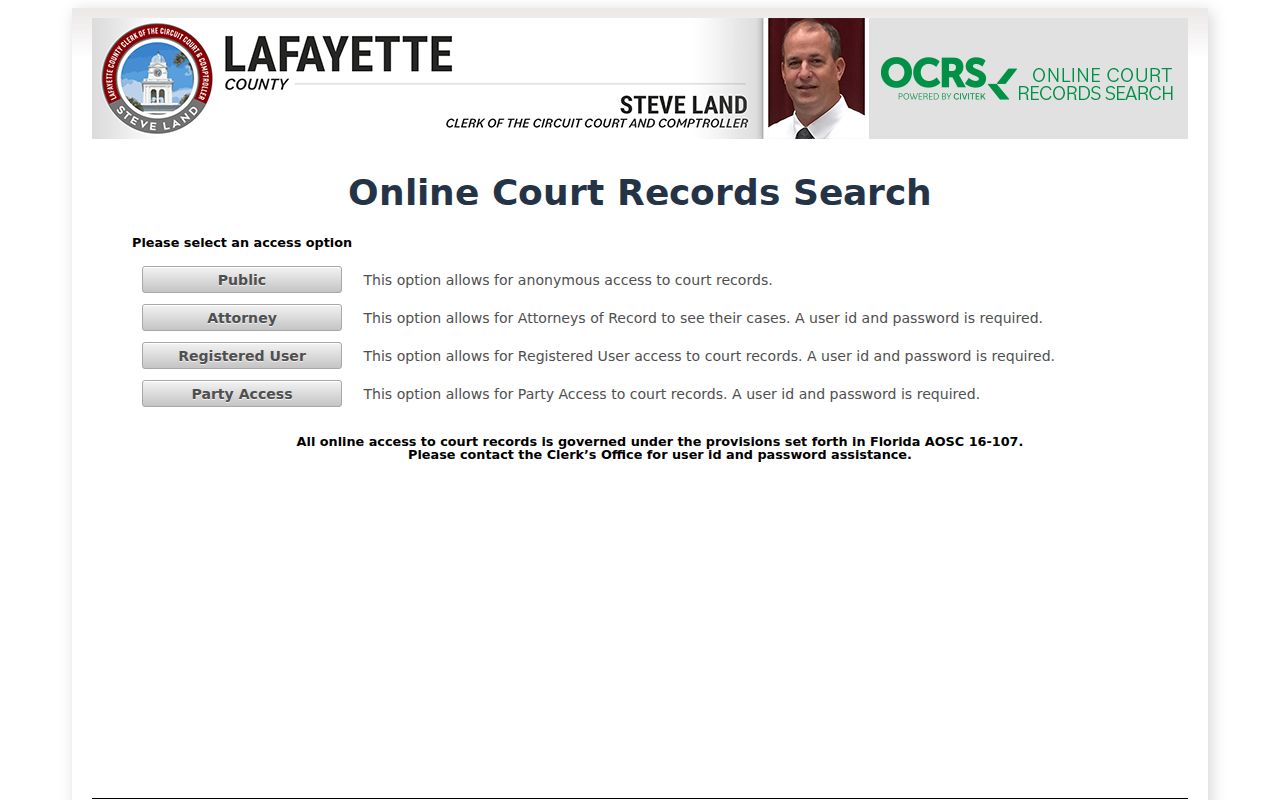
Those roles explain why two users may not see the same document access.
Public Access Laws
Florida's constitutional open-government right and Chapter 119 support inspection of nonexempt Lafayette County public records. No magic request form is required. A clear request should describe the event, date range, location, record type, and preferred format. The agency may charge lawful duplication or special-service costs, but the Lafayette sheriff page publishes no fixed local fee schedule or guaranteed response time.
Key Statutes:
Chapter 119, Florida Statutes - governs access to nonexempt state and local public records.
Chapter 943, Florida Statutes - governs the state repository, dissemination, review, and record relief.
Florida Rule of General Practice and Judicial Administration 2.420 - controls public access and confidentiality in court records.
Section 775.21, Florida Statutes - governs sexual-predator registration and misuse of registry information.
Lafayette County Warrant Verification
The sheriff directs users to the FCIC Public Access System as a statewide lead. It accepts name, race, sex, birth date or age, and a CAPTCHA. The system refreshes daily, yet it warns that a result may be incomplete or stale. A possible match is not proof that a warrant remains active.
Call LCSO at 386-294-1222 to verify status. The related OCRS docket may show where a bench warrant began, but it is not a real-time clearance check. Do not confront a listed person or assume an unannounced courthouse visit will resolve the matter safely.
Sealed, Expunged & Restricted
Juvenile cases, protected victim or minor identities, active investigative material, and personal identifiers may be confidential or redacted. Court-ordered sealing and expunction remove eligible material from ordinary public dissemination, while laws preserve narrow confidential access and disclosure exceptions.
For a Lafayette County case, identify the exact OCRS file, obtain the disposition from the clerk, review current FDLE certificate and application rules, and file in the court that handled the matter. Section 943.0584 lists disqualifying offenses. Sections 943.0585 and 943.059 govern court-ordered expunction and sealing, while section 943.0595 provides certain automatic sealing. A dismissal does not erase a public file by itself.
Lafayette County Custody Transfers
Use the Lafayette County Jail phone for pretrial detention and local sentences. After a state prison sentence or placement on felony supervision, use the FDC Corrections Offender Information Network. Its DC Number is an FDC identifier, not a Lafayette booking or court number. The search omits county jail and county probation.
The official FDC search page shows the prison and felony-supervision route.
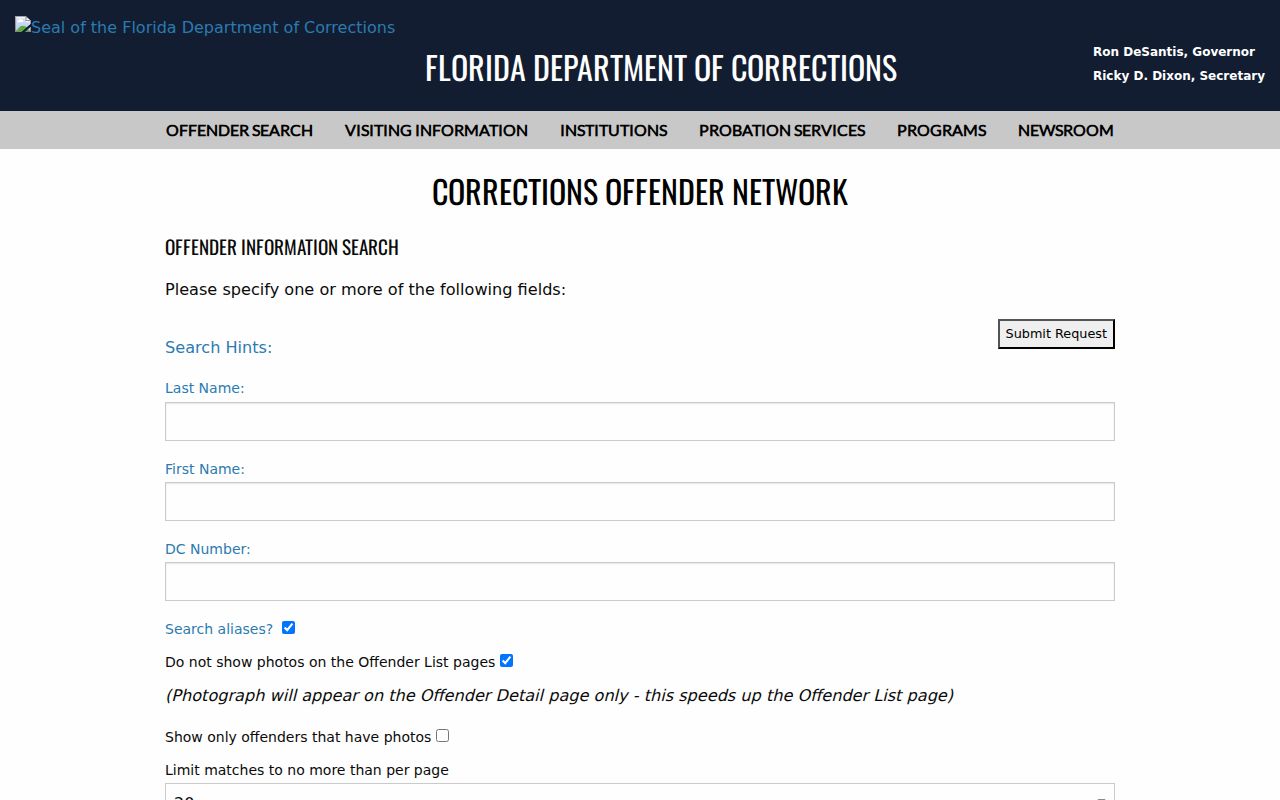
A blank FDC result does not rule out local custody or misdemeanor probation.
Lafayette County Justice in Mayo
Mayo is Lafayette County's only incorporated town. It has no separate police department or municipal criminal court portal in the official source inventory. The sheriff serves Mayo and the full county, while filed criminal matters move to Circuit or County Court. This countywide structure is why local record searches center on three nearby offices rather than separate town systems.
The courthouse is at 120 West Main Street, the sheriff headquarters is at 231 NW Monroe Avenue, and the jail is at 178 NW Crawford Street. Before visiting court, know that controlled entry, screening, and limits on public recording apply. Public hours for the clerk are weekdays from 8 a.m. to 5 p.m.
The Third Judicial Circuit courthouse page provides the official courthouse view and local court details.
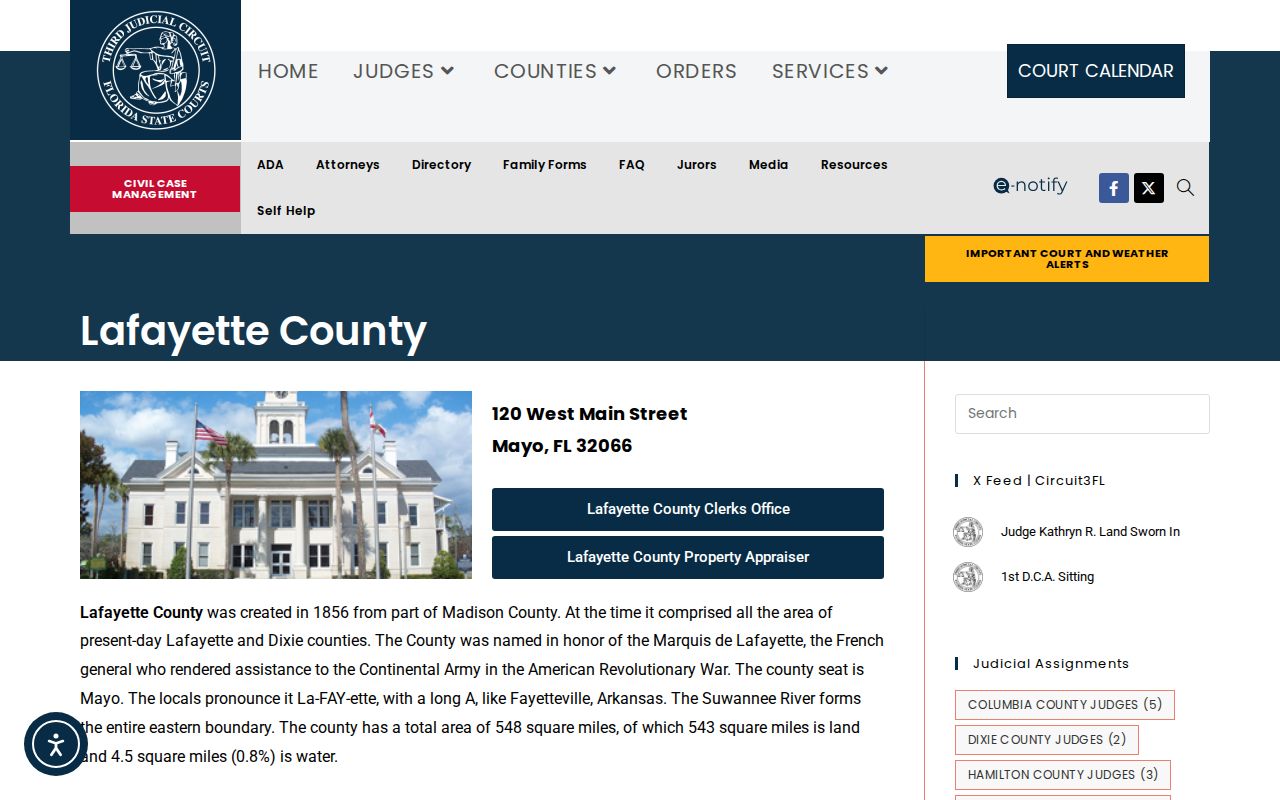
The building remains the center for both felony and misdemeanor court records.
Lafayette County Sheriff Record Limits
The official Lafayette Co. Sheriffs Dept. app advertises tips, crime reporting, interactive features, and public-safety information. Its store text does not verify a jail roster, warrant search, criminal-history search, or records-request portal. CommunityConnect is separate and sends one-way status texts after cellular 911 contact. Those messages never request payment or financial details.
The current Lafayette County Sheriff's Office homepage identifies the agency that serves Mayo and the rest of the county.

For records, the direct phone, email, mail, and counter channels remain the documented choices.
Criminal Records by City in Lafayette County
Mayo is the only incorporated municipality in Lafayette County. The sheriff provides town and county law enforcement, and the county clerk keeps cases after filing. The Mayo record guide explains that shared structure, the town ordinance library, and the proper route for each local record without inventing a city police portal.
Mayo Criminal History
Only incorporated town · LCSO and Lafayette County courts hold criminal records
Lafayette County Record Office Contacts
Use the office tied to the document. Court questions go to the clerk. Reports and warrant confirmation go to the sheriff. Current custody goes to the jail. Calling first can prevent a trip when a file is confidential, archived, or held by another agency.
Lafayette County Clerk
120 West Main Street
Mayo, FL 32066
386-294-1600
Monday-Friday, 8 a.m.-5 p.m.
Lafayette County Sheriff
231 NW Monroe Avenue
Mayo, FL 32066
386-294-1222
Weekdays, 8 a.m.-5 p.m.; counter closed noon-1
Lafayette County Jail
178 NW Crawford Street
Mayo, FL 32066
386-294-4381
Custody calls accepted around the clock
The Third Circuit State Attorney handles charging, while the Third Circuit Public Defender lists its regional Live Oak office. Those regional offices affect cases, but the Lafayette clerk remains the local case-record custodian.